
5 Traits of Thriving Restaurants | Reproducing Success with Numbers
5 Traits of Thriving Restaurants | Reproducing Success with Numbers
Thriving restaurants share common patterns that go beyond momentum or intuition. In the consulting work I've done, the stores generating revenue but failing to retain profit almost always had weak metrics tracking and underdeveloped repeat-visit funnels.
Thriving restaurants share common patterns that go beyond momentum or intuition. In the consulting work I've done, the stores generating revenue but failing to retain profit almost always had weak metrics tracking and underdeveloped repeat-visit funnels.
This article breaks down the seemingly vague concept of a "thriving restaurant" into five observable axes -- concept, QSC+H, metrics management, new customer acquisition, and repeat visit design -- for owners and managers who want to move from gut-feel success to measurable, reproducible operations.
Revenue deconstructs into customer count times average spend. Layer in FL cost, revenue per tsubo (a Japanese unit of floor area, roughly 3.3 square meters), and revenue per labor hour, and the conditions for a profitable restaurant become much more reproducible.
By the end, you'll have a 7-day action plan -- so you'll know exactly what to measure and where to start fixing things by tomorrow.
What You Need to Know Before Chasing "Thriving Restaurant" Status
The term "thriving restaurant" gets thrown around a lot, but it has no legal definition. In this article, we define it by three conditions: profit remains, customers return, and operations are stable. A restaurant with lines out the door but ballooning food costs, exhausted staff, and no regular customer base can't honestly be called strong from a business perspective. Visual bustling and financial health are separate things that need separate evaluation.
Restaurant revenue fundamentally breaks down into customer count times average spend per customer. But for management decisions, revenue alone isn't enough. You need to track FL cost (food + labor as a percentage of revenue), revenue per tsubo (monthly revenue divided by floor area in tsubo), revenue per labor hour (total revenue divided by total labor hours), and repeat visit rate to actually determine whether profit is being retained. Industry publications like Gurunavi Tsushin and FOODGYM consistently emphasize examining profit structure before raw revenue.
Having benchmark figures in mind makes it easier to verbalize what feels off on the ground. Industry practical benchmarks (from sources like FOODGYM) suggest that for izakaya-style restaurants, monthly revenue per tsubo of around 200,000 yen (~$1,350 USD) represents an average restaurant, above 300,000 yen (~$2,000 USD) indicates a thriving one, and below 100,000 yen (~$670 USD) signals red-flag territory. FL cost is generally targeted at 60% or below of revenue, and revenue per labor hour references around 4,000-6,000 yen (~$27-40 USD) as a practical range. Repeat customer ratios and acquisition costs also vary significantly by business format and marketing approach. These are practical benchmarks only -- ultimately, validation against your own store's data is what matters.
In one case I worked on, a restaurant was packed on weekend evenings and looked highly successful from outside. But when we calculated revenue per labor hour, the staffing during shoulder hours around the peak was too heavy. The busy-time impression was pulling perception while non-peak labor was excessive. After restructuring prep-time and slow-period shifts and clarifying roles, labor costs aligned without losing peak-hour momentum, and the store turned profitable. Even on days when the floor feels like "we were really busy today," converting that to numbers reveals clear improvement points. This is the critical distinction: looking busy and operating profitably are not the same thing.
💡 Tip
Lines and full houses signal customer-drawing power, but evaluating management works better through "what remained" rather than "what sold."
Sales channel diversification has also become a baseline consideration in restaurant management. Japan's delivery and takeout market expanded to 796.7 billion yen (~$5.3 billion USD) in 2024, making off-premises revenue impossible to ignore. However, third-party delivery platform fees vary by contract, region, and plan -- secondary sources commonly cite "around 30-35%," which is the realistic framing (always verify with each platform's merchant terms). A simple calculation example: at 35% commission on a 1,000 yen (~$6.70 USD) order, the restaurant retains about 650 yen (~$4.35 USD) -- but this is purely illustrative. Add food cost, packaging materials, and kitchen load, and revenue growth may not translate to cash improvement. Dine-in, takeout, and delivery are all revenue channels, but their profit structures differ fundamentally.
Funding context also makes delaying metrics management difficult. The Japan Finance Corporation's 2024 New Business Survey reports average startup costs of 9.85 million yen (~$66,000 USD) with a median of 5.8 million yen (~$39,000 USD). The gap between average and median tells us some restaurants start lean while others require more investment than planned. Either way, opening-day cash reserves are rarely generous. That's why the discussion about building a thriving restaurant needs to start not months after opening, but from the pre-opening stage -- deciding "which numbers tell us if we're healthy." Numbers aren't for retroactive bookkeeping adjustments; they're an early warning system for business health.
5 Traits Shared by Thriving Restaurants
1. A Clear Concept
Observing thriving restaurants, the first commonality is that "who you serve, what you offer, at what price point, and what experience you deliver" communicates in a single sentence. Stores where this is fuzzy see inconsistent decisions across menus, photos, service, interior design, and promotions. Stores with a clear concept align priorities easily and onboard staff faster.
At one consulting client, simply articulating "who is this restaurant for" in one line accelerated decision-making dramatically. Previously, photo tone, menu structure, and interior presentation were debated every time. Once they settled on "a place where professionals in their 30s can unwind with a slightly elevated experience after work," discount-driven marketing stopped, and food presentation, lighting, and drink suggestions all fell into alignment. The result: messaging matched customer expectations, and customer acquisition efficiency improved. A concept isn't about crafting pretty words -- it's a management device that speeds up operational decisions.
2. Rigorous QSC+H
Even with a defined concept, inconsistent on-floor quality prevents sustained success. The foundation here is QSC+H: Quality, Service, Cleanliness, plus Hospitality -- anticipating the customer's needs before they express them. Thriving restaurants maintain these four not through determination but through checklists.
The key is eliminating "we think we're doing fine." For restaurants, that means turning food serving temperature, plating consistency, tabletop cleanliness, initial greeting after entry, and farewell at exit into verifiable checklist items. Creating the list alone isn't enough -- specifying when it gets checked (pre-opening, post-peak, pre-closing) makes it operational. QSC+H isn't a philosophy; it's a system that includes frequency.
💡 Tip
QSC+H becomes a store standard only when you've decided "who checks what, when, and how" -- not just "what to protect."
3. Management by Numbers
Thriving restaurants don't have sharper intuition -- they verify intuition with numbers. Revenue breaks into customer count times average spend as the baseline, but what comes next matters more. Daily tracking covers revenue, customer count, and average spend. Weekly reviews examine FL cost and revenue per labor hour. Monthly checks include revenue per tsubo. Stores running this cycle catch problems early.
In restaurants, whether customer count dropped or average spend dropped requires completely different responses. FL cost -- food plus labor divided by revenue -- targets 60% or below as one benchmark. Revenue per labor hour references 4,000-6,000 yen (~$27-40 USD) as a practical range. Monthly, revenue per tsubo of around 200,000 yen (~$1,350 USD) represents average for izakaya formats, with 300,000+ yen (~$2,000+ USD) indicating thriving territory. These are reference benchmarks that vary by format and location.
What I notice consistently on the ground: owners who struggle with numbers tend to look only at month-end total revenue. But what actually matters is decomposition over totals. Did customer count increase? Did average spend rise? Were shifts overstaffed? Stores that can make these distinctions improve faster.
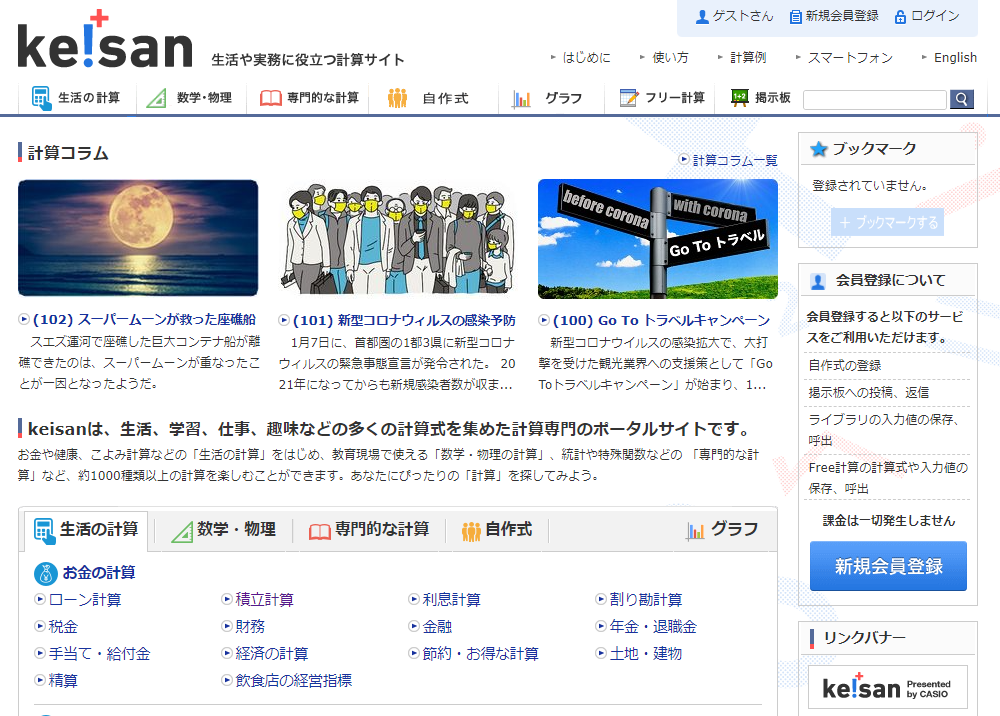
身近な計算から複雑な計算まで手軽に実行【Ke!san】
Ke!sanは、記念日を割り出してくれる日数計算から、ややこしいイメージのある複利計算、税金の計算、Webの費用対利益、惑星の出没計算、座標点で囲まれる多角形の面積など、様々な計算をすぐにこなしてくれるツールです。
4b-media.net4. New Customer Acquisition Funnels
Thriving restaurants get discovered before they get praised for being "delicious" or "skilled." The critical distinction for new customer acquisition is separating MEO (Map Engine Optimization via Google Business Profile) from SNS. Google Business Profile is the "funnel for people actively searching," while SNS is the "funnel for people who aren't planning to visit yet." Conflating these blurs your messaging.
For restaurants, simply having current business hours, menu photos, interior photos, and recent posts on Google Business Profile reduces pre-visit anxiety. Instagram and TikTok, meanwhile, excel at conveying food aesthetics, the owner's personality, and peak-hour atmosphere. MEO for high-intent searchers, SNS for latent awareness -- that's the role division.
5. Repeat Visit Funnels
What sustains thriving restaurants isn't just new customer volume -- it's the fact that reasons to return are designed in. Generally, acquiring a new customer costs about 5x more than retaining an existing one, and restaurants with higher repeat customer ratios tend to have more stable operations. Repeat visits need to be engineered as funnels, not left to "hope they come back."
Effective tactics for restaurants include membership conversion, creating next-visit triggers, and message automation. Getting customers to register for a LINE Official Account at checkout, then sending thank-you messages, limited menu announcements, and weekday promotions transforms a restaurant from "somewhere I go when I think of it" to "somewhere I have a reason to return to." Note: LINE Official Account plans and pricing are subject to change, so the figures mentioned here (e.g., Light Plan ~5,000 yen (~$33 USD), Standard Plan ~15,000 yen (~$100 USD)) are approximations. Check the official page for current free tier allowances and billing structures.
The important principle: don't rely solely on discounts. Thriving restaurants' repeat funnels aren't just "I go back because it's cheap" -- they create the state of "it suited me" and "I have a reason to use it again." Seasonal menus, limited events, maintenance suggestions -- these create reasons to return. Stores that treat repeat visits as designable rather than coincidental experience smaller revenue fluctuations.
What Thriving Restaurants Actually Track
Key KPI Formulas and Benchmarks
Breaking free from intuition-based management starts with "decompose revenue before looking at it." Restaurant revenue at its most basic: Revenue = Customer count x Average spend. Customer count further breaks down into Seats x Turnover rate x Operating days. Even a 20-seat restaurant looks completely different at 1.5 turns per day versus 2 turns. Strategies for increasing average spend versus increasing turnover rate require different tactics, so decomposing first to find the bottleneck is essential.
Turnover rate isn't simply "get customers to eat faster." It measures whether seats are filled during peak hours and whether too many seats sit empty during idle periods.
For profitability, FL cost is critical: (Food cost + Labor cost) / Revenue x 100. The general benchmark is 60% or below. FL cost is better "designed" than "reduced" -- that mindset produces more stable management decisions.
Revenue per tsubo measures how effectively floor area converts to revenue: Monthly revenue / Floor area in tsubo. Revenue per labor hour shows whether staffing matches revenue: Revenue / Total labor hours, with 4,000-6,000 yen (~$27-40 USD) as a reference range.
| Metric | Purpose | Improvement levers |
|---|---|---|
| Revenue per tsubo | Whether floor area generates revenue | Seating design, turnover rate, flow, operating hour optimization |
| FL cost | Whether food and labor costs are too heavy relative to revenue | Cost-of-goods reduction, ordering accuracy, pricing design, shift optimization |
| Revenue per labor hour | Whether staffing matches revenue output | Time-slot shift adjustment, operation simplification, peak-focused staffing |
Hypothetical Example: 20-Seat Cafe KPI Diagnosis
Place some numbers on a 20-seat cafe. Monthly revenue of 1,200,000 yen (~$8,000 USD), average spend 1,200 yen (~$8 USD) = 1,000 monthly customers, 40 per day over 25 operating days, giving a turnover rate of 2 turns (40 / 20 seats).
Monthly food cost 360,000 yen (~$2,400 USD) + labor 420,000 yen (~$2,800 USD) = FL cost of 65% (heavy, profit retention difficult). 300 total labor hours gives revenue per labor hour of 4,000 yen (~$27 USD) (bottom of range). 10-tsubo floor gives revenue per tsubo of 120,000 yen (~$800 USD) (not strong).
The path to profitability here lies in FL cost and space efficiency improvement rather than forcing average spend up.
Practical Improvement Steps for Building a Thriving Restaurant
7-Day Action Plan
Building a thriving restaurant works better by sequencing improvements tightly rather than adding parallel initiatives. The order that reveals cause-and-effect most clearly: numbers, concept, floor quality, acquisition funnels, repeat funnels.
- Day 1: Assess current state (60-90 min) -- Compile last month's revenue, customer count, average spend, total labor hours, food cost, labor cost, and floor area. Calculate revenue per labor hour, FL cost, and revenue per tsubo.
- Day 2: Clarify concept (2 hours) -- Write "who, what, at what price, and why they choose you" on one page.
- Day 3: QSC checklist (60 min) -- Create a 20-item checklist with a daily check time.
- Day 4: Acquisition funnel (90 min) -- Update Google Business Profile, add 10 photos, set categories/attributes, establish weekly posting format.
- Day 5: Repeat visit design (90 min) -- Implement one mechanism: LINE Official Account, stamp card, or next-visit booking.
- Day 6: Team briefing and test launch -- Share changes with staff; assign specific responsibilities.
- Day 7: First review -- Identify learnings; separate "continue" from "stop" rather than adding more.
For regulations, display rules, or legally sensitive promotional elements, verify with the relevant authorities for current requirements. In practice, stores that specify who does what, when, and where make steadier progress than those that just plan tactics.
Industry-Specific Approaches
Restaurants: Simultaneously Raising Average Spend and Turnover
The battleground for restaurants is the multiplication of average spend and turnover rate. Chasing only average spend creates heavy menus that extend dwell time; chasing only turnover drops satisfaction and weakens repeat visits. Designing this tension is the core of building a thriving restaurant.
For average spend, menu mix outperforms simple price increases. Profitable drinks, additional toppings, and set proposals -- woven naturally into the ordering flow -- lift average spend without straining the floor.
For turnover, seating design and flow design matter more than service speed. Two-top demand with only four-top seating, checkout bottlenecks at the entrance, and crossing service/clearing paths all cap revenue efficiency despite apparent busyness.
Salons: Stabilizing Through Return Rate, Nomination Ratio, and Next-Visit Booking
Salons have a physical cap on daily customer volume, shifting the stability axis to return rate, nomination ratio, and pricing. Next-visit booking at checkout dramatically reduces return uncertainty. Carte (customer record) management -- logging prior concerns, recommendations, next suggested timing, and retail product reactions -- becomes the design blueprint for return rate improvement.
Retail: Maximizing Revenue Density Through Space Efficiency and Customer Flow
For retail, the KPI emphasis falls on revenue per tsubo and customer flow design. Strong stores don't just stock good products -- they control placement, visibility, and cross-purchase triggers. Cross-merchandising (placing items by use-case rather than category) lifts both average spend and items per transaction.
Across all three industries, the shared foundation remains: clear concept, stable QSC+H, and consistent metrics tracking. Which KPIs take center stage varies by format, but thriving stores all convert floor-level intuition into numbers and build daily decisions on that basis.
Common Failure Patterns and Countermeasures
Price-Only Acquisition
The most frequent failure: making discounts the core acquisition strategy. Discounts generate quick response, but customers acquired on price compare on price. When the only reason to choose your store is "it's cheap," margins compress and busyness doesn't translate to profit.
Vague Concept with Active Marketing
Stores that can't describe their concept in one sentence see scattered messaging across signage, photos, menus, and social posts. The customer impression blurs accordingly.
Ignoring Numbers and Running on Feel
Stores running on intuition hear more "feels like things are slow lately" and "busy but nothing's left." Numbers are the business health check -- without them, countermeasures become high-variance gambles.
Strong SNS with Weak In-Store Experience
SNS drives new visits, but if the in-store experience doesn't match the expectation set online, repeat visits don't follow. QSC+H must be fixed first.
Owner-Dependent Operations
When quality drops on the owner's days off, that's a reproducibility problem. Converting the owner's standards into checklists, manuals, and training flows creates sustainable quality.
| Failure pattern | Likely state | Countermeasure |
|---|---|---|
| Price-only acquisition | Visits occur but margins are thin; discounts become permanent | Design selection reasons through menu, service, and atmosphere; use discounts only with clear purpose |
| Vague concept | Messaging and storefront presentation scatter; unclear who the restaurant serves | Define "who, what, at what price, why" in one sentence; reflect in signage, photos, and menu |
| Ignoring numbers | Countermeasures rely on guesswork; hit-or-miss improvements | Select and visualize daily/weekly/monthly KPIs; share via dashboard |
| Strong SNS, weak floor | New customers arrive but experience-expectation gap prevents return visits | Fix QSC+H first; use SNS to accurately convey the actual experience |
| Owner-dependent operations | Quality and operations become unstable on owner's absence | Extract into checklists, concise manuals, and training flows |
Summary | Your First 7 Days
When numbers become visible, decisions get clearer. Across the stores I've worked with, those that defined which metrics to watch in the first 7 days -- then aligned acquisition funnels, floor standards, and repeat mechanisms all at once -- made faster decisions and eliminated unnecessary operational confusion. Start narrow: limit this week's actions to four items. Get your store's "why customers choose us -- signature dish, service, or atmosphere" into a single statement and align marketing and in-store presentation accordingly. For regulatory matters like late-night alcohol service notifications, proceed while checking with the relevant authorities for current requirements.
Calculate at least one KPI (customer count, average spend, FL cost, revenue per labor hour)
Break today's revenue into at least customer count or average spend. A single calculation shifts conversations from intuition to data.
Update Google Business Profile with 10 photos and 1 post
Review business hours, holidays, and menu presentation. Add interior, exterior, and product photos. Write one post so the search results page communicates a reason to visit.
Create an in-store QSC checklist and start daily checks
Consolidate the items most prone to inconsistency in cleanliness, service, and product delivery onto a single sheet. Check daily before opening or after close. This is step one for removing owner-dependency.
Set up one repeat-visit mechanism for existing customers (LINE / stamp card / next-visit booking)
Choose one from LINE Official Account, stamp card, or next-visit booking and implement it, including the checkout-time prompt. Building the reason to return before chasing new customers produces a stronger foundation.
Related Articles
How to Choose and Set Up Cashless Payments for Your Store in Japan: Fee Comparison Guide
Running cash-only is costing you sales you can't see — and creating daily friction you don't have to live with. Before you commit to any service, run a quick estimate: multiply your monthly revenue by your expected cashless ratio and the processing rate. That one number makes the decision a lot easier.
Japan's Small Business Grants & Subsidies: A Practical Guide for Independent Shop Owners
Subsidies (補助金) and grants (助成金) sound alike but work very differently — subsidies run through METI on a competitive application basis, while grants run through the Ministry of Health, Labour and Welfare on a requirement-fulfillment basis. This guide unpacks that distinction first, then narrows the field to the three or four programs most relevant to small independent shops: the Small Business Sustainability Subsidy, the IT Introduction Subsidy, and key employment-related grants.
How to Improve Store Profit Margins in Japan: Benchmarks and Strategies by Business Type
Revenue is coming in, but somehow money isn't staying. The cause can't be identified by looking at revenue alone — only when you examine your profit margin does the real picture emerge. For restaurant, salon, and retail store owners in Japan who are 1–5 years into operations, this guide works through gross margin and operating margin calculations, food cost ratio, labor cost ratio, FL cost analysis, industry benchmarks, and self-diagnosis.
How to Cut Fixed Costs at Your Store in Japan: 10 Categories to Review
Even when revenue is stagnant, fixed costs are one of the fastest levers for improving profitability. Because a single reduction in fixed costs compounds every month, store owners in Japan often find it more impactful to address fixed costs before working on the cost of goods side.